
Design and development of the Avro Vulcan
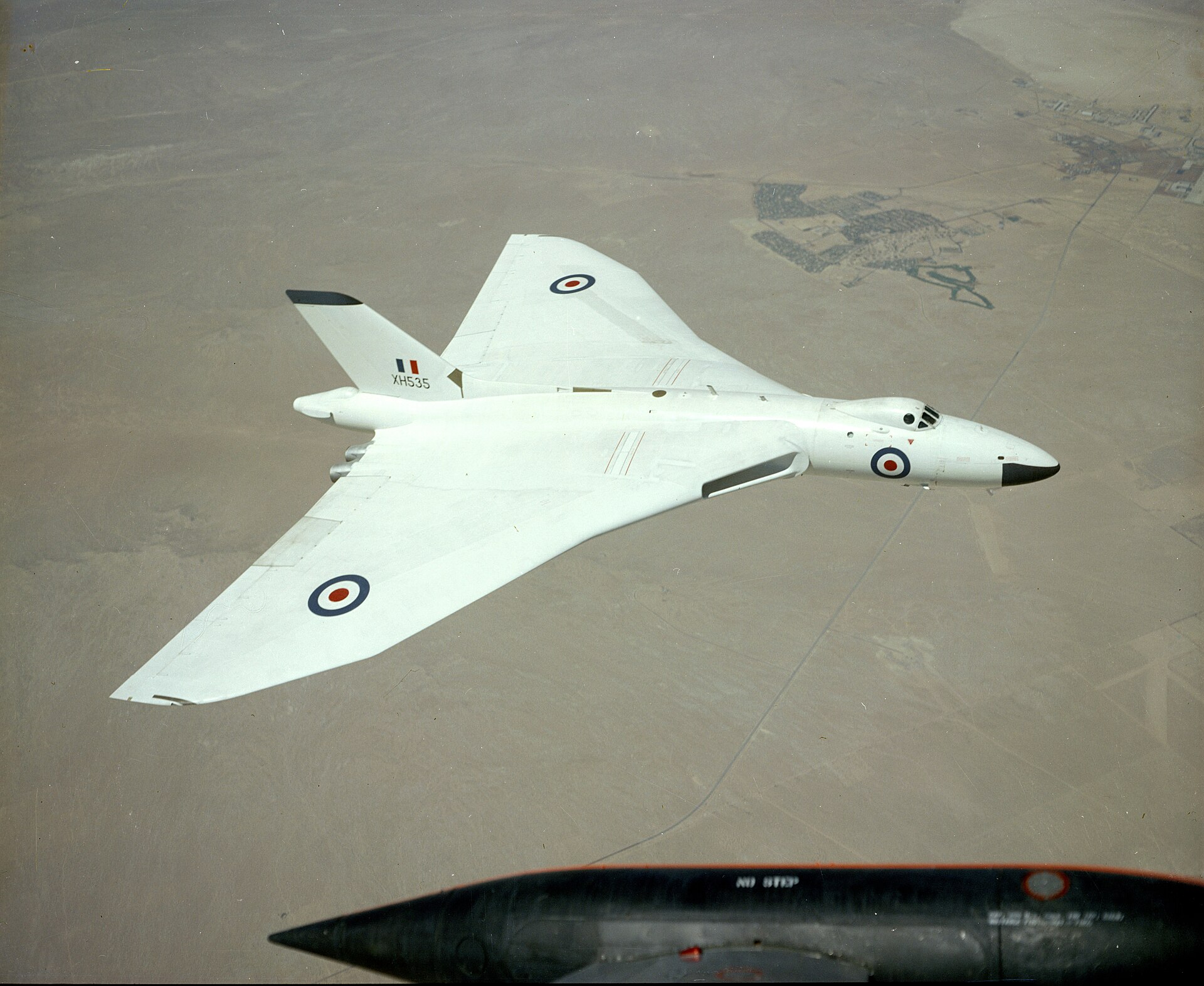
The Avro Vulcan began as a drawing-office answer to a brutal specification. In 1946 the Air Ministry asked British industry for a jet bomber that could carry a nuclear weapon to a target 1,500 nautical miles from base, cruise high and fast, and still operate from existing RAF runways. The paper became B.35/46. Three firms produced aircraft that entered service: Vickers the Valiant, Handley Page the Victor, Avro the Vulcan. Only the Vulcan was a pure delta.
Chadwick, Davies and Type 698
Avro’s wartime Lancaster team was led by Roy Chadwick. He sketched a four-jet, tailless delta — internally Type 698 — because a large thin wing promised high-altitude lift without a forest of spars and a conventional tail. Chadwick was killed in the Avro Tudor crash of August 1947. Stuart Davies took the project on. The delta stayed. What changed, repeatedly, was the detail: engines, intakes, the shape of the leading edge, and how much electronics could be stuffed into a nose that also had to be a radome.
A family of one-third-scale research aircraft, the Avro 707, flew from 1949 to prove that a large delta could be controlled at low speed. Those little jets were not toys. They taught Avro about pitch, about airbrakes, and about the unpleasant corners of the envelope that a 100-foot bomber would otherwise have discovered the hard way.
VX770 and the 1952 first flight
Prototype VX770 flew on 30 August 1952 from Woodford, with Avro’s Roly Falk at the controls. Early photographs show a clean, almost schematic aeroplane: four Armstrong Siddeley Sapphire engines in the first prototype (Olympus followed), a tall undercarriage, and a cockpit perched on a very long nose. Falk later rolled the Vulcan at the 1955 Farnborough show — a gesture that still annoys and delights in equal measure — because the type had the control power to do it and the company wanted the world to notice.
The second prototype, VX777, introduced a more representative Olympus installation and a wing closer to production. The production B.1 that reached the RAF in 1956 still had a relatively simple electronics fit compared with the B.2 that followed, but the essential architecture was there: five crew, a huge bomb bay, and a nose that existed to house H2S and the Navigation and Bombing System.
Why the B.2 exists
The B.2 was not a cosmetic mark. It took a larger wing of compound leading-edge sweep, more powerful Bristol Siddeley Olympus engines (201, then 301 in later aircraft), a strengthened airframe, and a much more capable electrical and electronic installation. First flight of a B.2 was in 1958; squadrons received the mark from 1960. The bigger wing and extra power were about height, range and the ability to lift Blue Steel. The extra electrics were about radar, ECM and the growing appetite of a Cold War bomber for cooling, power and aerials.
In parallel Avro and the RAF learned that a high-altitude bomber could be seen and shot at. The later B.2 airframe — and its terrain-following radar — is the airframe of the low-level years, the tanker conversions, and almost every preserved Vulcan you can still walk under. For a mark-by-mark comparison see the variants guide.
Production and the name
Including two prototypes, 136 Vulcans were built at Woodford. The name, chosen in the RAF’s classical vein, is the Roman god of fire and the forge — apt for an aircraft whose engines could be heard counties away. It is also why a modern civilian desk display can borrow the word without describing the 1950s NBS: the brand is the bomber’s silhouette, not its classified boxes.
What Avro actually delivered was a flying radar station with a bomb bay. The next essay in this section places that aeroplane inside the V-Force it was built to serve.