
Operation Black Buck
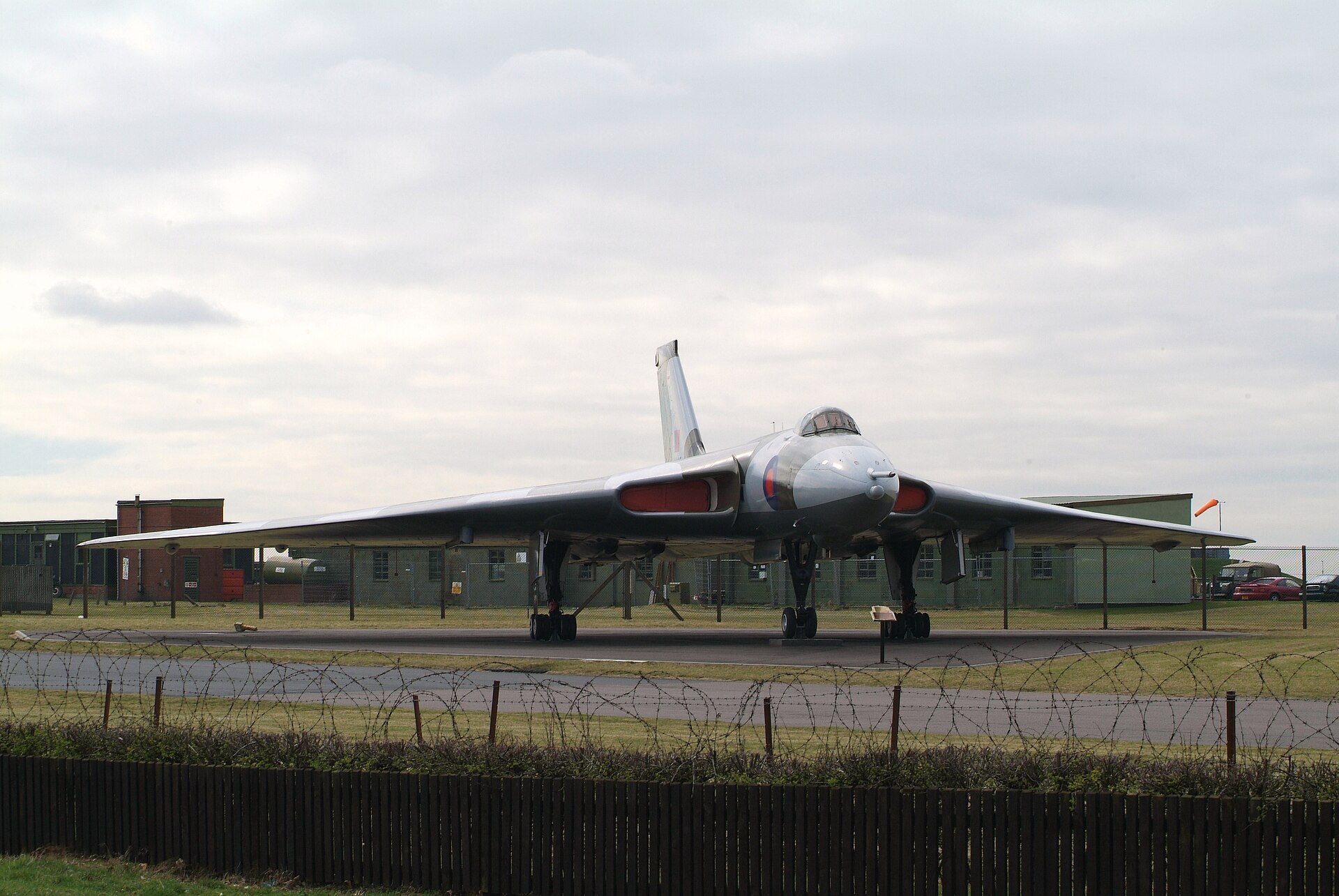
On the night of 30 April / 1 May 1982, an Avro Vulcan of No. 44 Squadron left Wideawake airfield on Ascension Island, met a chain of Victor tankers over the Atlantic, and dropped twenty-one 1,000 lb bombs on the runway at Port Stanley. The raid was coded Black Buck 1. It was the type’s only war, and it was flown by an aircraft designed to deliver nuclear weapons against the Soviet Union.
Why a Vulcan?
After Argentina seized the Falkland Islands, Britain needed to signal that the islands were not out of reach, and to deny Stanley’s runway to fast jets if possible. The distance from Ascension is roughly 3,900 miles one way. No RAF bomber then in service could make that trip without air-to-air refuelling; the Vulcan could carry a useful conventional load and still air-refuel; and Waddington still had crews current enough, just, to be converted onto the wartime task.
The tanker bill was enormous. A single Vulcan over the Falklands required a package of Victors, themselves refuelling each other, to put enough fuel in the right sky at the right time. Several planned sorties were cancelled when the tanker plan broke. The raids that went ahead were as much a triumph of planning and AAR as of bombing.
Black Buck 1 — XM607
The primary aircraft for the first raid became unserviceable; XM607, flown by Flight Lieutenant Martin Withers and crew, took the mission. Navigation over the ocean used the NBS, astro and radio aids. The attack itself used H2S to find a short runway on a dark island. One bomb cratered the runway. The others fell alongside. Operationally, the crater mattered less than the message: the runway could not be treated as safe, and Argentine fast-jet operations from Stanley were constrained. Withers was awarded the Distinguished Flying Cross.

Later Black Buck sorties
Further conventional bombing raids followed, with mixed technical fortune. Later missions (Black Buck 4, 5 and 6 in the usual numbering) shifted toward suppression of Argentine air-defence radars using AGM-45 Shrike missiles. XM597 became famous for a diversion into Brazil after a probe broke on the return from a Shrike mission — an episode that belongs in the war’s footnotes and in every Vulcan enthusiast’s store of stories.
Not every allocated night produced a successful attack. Weather, tankers, unserviceabilities and the sheer length of the trip made Black Buck a thin thread, not a campaign of daily pounding. That is part of why the raids are remembered: they were scarce, loud, and politically useful.
Radar’s part
Without H2S there is no Black Buck bombing solution worth the fuel. Without air-to-air refuelling there is no aircraft over the target. Without crews who had spent decades practising the NBS there is no interpretation of a small airfield on a radar scope after a night over water. The mission is therefore the public proof of this archive’s private thesis: the Vulcan was a radar aeroplane that happened to have a famous wing.
| Date of Black Buck 1 | 1 May 1982 |
|---|---|
| Aircraft | Vulcan B.2 XM607 (No. 44 Squadron) |
| Launch base | Wideawake, Ascension Island |
| Weapon (BB1) | 21 × 1,000 lb bombs |
| Later weapons | AGM-45 Shrike on anti-radar sorties |